Streetwear and Hip Hop

By Paola “ZKR” Zukar
AT 30 August - September 1998
For years, Hip Hop culture has influenced the outside world from which it was born and thrived, taking elements from it, re-elaborating them and throwing them back out transformed, with a distinct connotation of belonging.
Every single characteristic of the generation in question was influenced, with an ascendancy so strong that it still and increasingly affected the following generations. Aerosol art capable of reframing the urban environment and neighborhoods; music as a decisive driver and soundtrack of change; sports with a streak of showmanship and positive aggression that it had never had before; cinema with a newfound raw realism that painted portions of society rarely told; politics with a new consciousness driven by movements that would never want to retrace the paths of traditional parties; language with the ability to forge new terms and slang every second that can influence even the strict laws of marketing, all the way to the Internet, soft drinks, religion, photography, graphics, and of course clothing. From the very early years of its life, Hip Hop created its own strong sense of aesthetics regarding clothes, shoes, accessories, hairstyles and anything else related to outward appearance in general.In Italy, someone still struggles to find the link between the two opposing aspects of Culture, exteriority and interiority. The issue is that in the Western world that we have all known for about five centuries, these two aspects are no longer opposed, in fact most of the time they coincide. This is because of the fact that, as a New Yorker friend of mine, who both knows a lot about Hip Hop and style, said brilliantly and lapidarily, “The world I come from is ‘materialistic as a muthafuc*er.’”.
I have left the colorful original expression because I will never be able to find translations of equal level and intensity but, for those who do not even remotely get to the crux of the matter, may I suggest that the world, and therefore the society around us, with its rules, we cannot annihilate or subdue it, but we can certainly condition it to our taste, until we can make ourselves like it, at least a little. Originally (and here Phase 2 and others of his cronies could give us tons of personal examples) the boys‘ imagination was all about creating a new flavor of sounds, alphabetical structures, dance steps and accessories never seen before. And clothing played a crucial role for anyone who wanted to apply themselves. Stile became part of Hip Hop from Day One, with very specific purposes: not to fit into any other category that had already been tried and tested. Cazal glasses, Kangol hats, leather jackets, Adidas Superstars, nylon t-shirts, super short and tight shorts, highly polished tracksuits, unlikely color combinations, ultra-fat laces, ski caps, brass buckles with one's name on them, Lee jeans, gold and/or silver chains... The 1970s were winding down and already the mc's were beginning to talk about what they wore; brands had always been an integral, though certainly not determinant, part of the discourse of young Afro-Latinos in New York's suburban suburbs; and where you couldn't come up with the amount of money to shell out to get that piece, along came the artisan below your house who created in his workshop what you wanted with the brand you preferred.
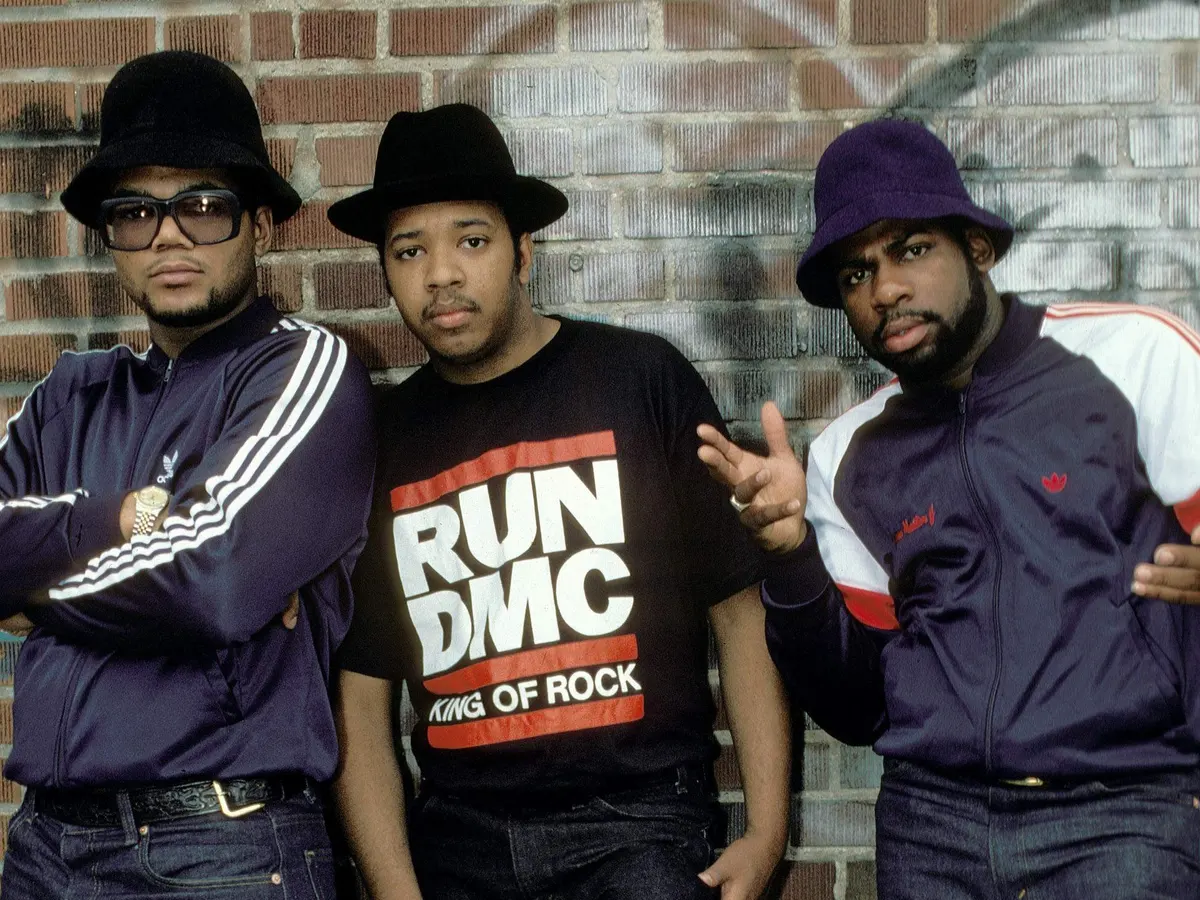
However, the undeniable consecration of the brand as an active part of the new Culture definitely came a few years later, with the worldwide success of Run DMC pushing Adidas to embarrassing heights, even dedicating a track of their own to it and basically forcing it to sponsor their tour and sales tenfold. That was the year of “My Adidas,” 1986, but the two mc's and DJ Jam Master Jay had been having fun rhyming about their clothing choices even earlier, as had some of their other associates, and on 1983“s ”Rock Box,“ they confidently assert: ”Calvin Klein's no friend of mine, don't want nobody's name on my behind, Lee's on my legs, sneakers on my feet, D by my side and Jay with the beat...“ (”Calvin Klein's no friend of mine, don't want nobody's name on my behind, Lee's on my legs, sneakers on my feet, DMC by my side and Jay with the beat..."). Calvin Klein later bounced back, but all the biggest names, from Versace to Ralph Lauren, bowed to the line imposed by the young suburbanites who, in the meantime, have grown up, made a life for themselves, and continue to decide what is best for them and millions of other kids around the world, both in music and shoes. Still the situation is evolving, but the diversification of style in rap and Hip Hop has certainly not diminished the need to spend a portion of one's salary on clothing. Italy is taking huge steps in this direction and we are, in all likelihood, the nation with the highest concentration of style designers, I think for a purely genetic reason. We collected the opinions of a few people trying to combine their love for Hip Hop with their skills and aptitudes to create something that is part of the business, builds an economic foundation from nothing, and possibly reinvests efforts into the Culture itself. Representing their brands, ideas and visions were Alberto “Skill To Deal”, Bad ‘Broke’ Bado, Claudio ‘Bastard’, Jonni and Giacomo ‘Savage’, Max ‘Gotti & Introw’, Fabrizio ‘Malas’, Luca ‘Slam Jam’ Benini, and Deemo’, Slam Jam's promotion consultant.
-What is the main purpose of your activity?
(Bado): “Let's put it this way, the other night I went to hear The Hill play in Udine and, I'll be honest, I still haven't gotten used to the pleasure it gives to see twenty or thirty people wearing your stuff. Hearing that Danno rhymes with my name pays me more than a salary, although I have to say that, so far, I haven't gotten anything serious out of it yet, because everything we're raking in we throw back into advertising, sponsorships, and clothing that we give out; I've never counted how much stuff I've given away, but I assure you it's a lot... Satisfaction in my work comes from the healthy natural selection that always occurs, and in any case there is to keep in mind that, good or bad, clothing represents in the immediate, at least a 50% of what one is. Then there is also the little boy who puts on baggy pants only when he leaves the house because his father does not want him to, and that is the most superficial and fashionable aspect of it. But it has always been like that: the 1970s were the punk years, the 1980s the new wave years, and probably the 1990s, in Italy, will be remembered as the years of Hip Hop, or it would be better to say streetwear...‘
(DeeMo’): “On the one hand you're screwed if you follow this talk, if you think of the whole thing as if it's eras. I have a certain appreciation for basic things that have managed to set a standard over any fashion. The philosophy of brands of certain firms that Slam Jam has chosen to import for Italy is just that. I think of Carhartt, Freshjive, Stussy... Cross Colours (American clothing brand from the 1980s, ed.) used to be powerful, now it doesn't exist anymore: these are economic misfortunes, but not only. People, in the U.S., created certain styles ‘before“ brands existed; in the end, you can pull your own style together even by buying things at the flea market...”
(Alberto): “Coming out with Skill To Deal was a need dictated by the lack of satisfactory products. Skill To Deal started in ’98 because only now have I found a company that gives me the opportunity to be able to make all the things I have in mind, and when the creative aspect collides with reality, if you don't have a company behind you, you don't make anything. This company, which has production capacity abroad, allows me to make special garments that I could not otherwise have and offer them to the public at a not very high cost. The trend in the industry in the coming years will be precisely to keep costs down, as no one has money to throw away, least of all the end user. My creative ability comes from experience and not from a school; I try to be original and not imitate things that already exist or leave out graphics as I have seen done. If we all worked hard together and dared more, we could stop aping the Americans and we could break their butts, since they are doing right now what Diesel and Replay were doing ten years ago. I would like to see Americans come to Italy and buy, besides Armani, something of ours...”
-Talking about packaged images, it is certain that looking at a good advertisement you already have everything ready in front of you, there is no need to go to the trouble of selecting a taste of your own, it applies to clothes but also to music with multimillion-dollar videos...
(DeeMo’): “The fact of advertising in newspapers and videos that present you with very specific images perhaps prevents other things from coming in, perhaps just as good, researched and interesting, just as it happens with Mtv that only shows mainstream stuff and excludes very good underground products. The fact of limiting oneself to buying only the stuff you see on Mtv or in the big American magazine, maybe can exclude the possibility for a small producer to propose his pure best stuff. Slam Jam in Italy is an importer of stuff that New York-based writers make that Aelle has talked about a bunch of times and that is a huge piece of our history. I'm talking about Futura 2000 for example, and its Project Dragon, a brand that makes very basic stuff, but there are also other very important brands like PNB Nation, formed by people connected to Hip Hop culture or skate culture... The fact that Puff Daddy doesn't carry it in the video, we, the people who suck ‘this stuff and want to feel part of a family of people on the same level, don't give a shit. Even the people who make stuff at Hilfiger's Culture don't give a f**k and that's for sure. Futura, if he meets the average user on the street, he is happy because he knows someone who does the same thing as him, someone he feels connected to. If we think about the success of camouflage fabric, camouflage, we quickly realize how our stuff was born, it's Army Surplus (the used U.S. Army, ed.), the same goes for Carhartt or Woolrich... People, maybe without having a lot of money in their pockets, pull a style out of what they can afford... Some styles were born out of just what you could afford...”
(Bado): “Here it is also about a different philosophy behind the production; even graphically you can see that it is about the evolution of Hip Hop, especially after seeing Futura's more recent works...”
(DeeMo’): “You can also refer back to some musical examples: for example, Futura graphically collaborates with certain labels, like Mo'Wax, that only a guy like Ice One can appreciate as Hip Hop, while for others it's too experimental stuff. You'd have to get some people in the time machine and transport them to Bambaataa's or Kool Herc's early parties in Bronx parks to show them that, back then, people played everything and that ’everything‘ was Hip Hop and that ’everything‘ was turned on its back by b-boys. Hip Hop was pushing the frontiers forward and if now part of this scene that comes to us in a more compact way has become a kind of immobile monolithic form, that's a problem of the scene, it's not a problem of the people who are pushing it further. It's a problem of the scene itself.’
-What were the beginnings of so-called streetwear in Italy?
(Luca Benini): “When I started, there was practically nothing. The beginning, in 1987, was bogus Def Jam t-shirts... In the span of one summer, I must have printed a hundred and sold as many. Then in 1988, there was the Run DMC stuff, Beastie Boys, Boogie Down Production, LL Cool J, even Adidas... After these things, the first major move was the importation of Troop in 1989; this brand, at that time, was very well known, thanks to the record covers of Stetsasonic and LL Cool J... Alberto from Wag (well-known streetwear store in Milan, ed.), was probably the only one who didn't lose out in this whole thing that was really tiny at the beginning. Through a guy from Bologna, I got in touch with the Koreans who produced Troop and were based in Manhattan; I tried to sell it around, but all the shopkeepers saw was a bad copy of Avirex.... In the beginning, Troop was the only one and the first one, globally, that was made for people in that area and had very good sales success; in New York, in 1988, ‘89, I think it came really close to the sales of sneakers from Nike or Adidas, stealing a very good chunk of the market from those two superpowers. At that point somebody kind of dropped a bombshell on those people, spreading a rumor that they were even funded by the Ku Klux Klan, so I sent a letter one day and it came back to me marked ‘non-existent addressee’... Around ‘91 Public Enemy's double lp came out and they were advertising their merchandise inside. I called them and went to their office, on Long Island, to deal with importing their stuff. It was really poorly made stuff, really bad quality, but enough of it was being sold at the time; what really turned me around, however, was Stussy. Since I was able to get this brand for Italy, it's been a whole succession of opportunities, from Freshjive to Carhartt. In the meantime there was the experience with Major Force... Whereas in the beginning, to sell a hundred t-shirts, you had to write Run DMC or Def Jam, we got together, Zero T, Deemo’ and I to think of something that wasn't copied, but was just ours. In 1991 the name didn't even exist-Deemo’ designed a t-shirt that said ‘Scribe,’ with wings on the sleeve, but the name was still Fruit Of The Loom, it was directly Zero T who designed the Major Force brand. I can also add that in ‘91 the 50% of sales was made exclusively thanks to Alberto and his store... Anyway we were making three t-shirts... The doing more really came in September 1992, when the dollar went from 1,200 lira to 1,600. There I found myself with Stussy pants that I could no longer sell at a competitive price because of the totally unfavorable exchange rate; since then we started Major Force production in earnest...”
(Alberto): “Initially I only made hats which were the easiest thing to make and later I continued with pants, but I was limited financially. The first real experience as a clothing line was with Uprock, together with Raptus and Rendo. In those days besides us there was Benini with the aforementioned Major Force by Zero T and Dee Mo’, but there was no real market as all the interest was concentrated in Milan and a few other cities.”
(Bado): “I started out as a joke; I used to make t-shirts for bands in my area but, around ‘90 I met Rusty who was designing and printing t-shirts on his own, he even bought the carousel, this machine with arms where you put the t-shirt on and screen print. Me, Mace and my current partner, Stephen had only heard about Major Force until Master Freez brought a t-shirt for us to look at, from then on we came up with a lot of ideas. Then we started with purely skate stuff, while the evolution to Hip Hop was automatic, because the two were very connected...”
-Do you agree on the connection between skate and Hip Hop?
(DeeMo’): “Whatever the Islamic fundamentalist says about the scene, there are street energies that go in the same direction; everyone gets along more or less well with people who have other energy journeys that are born on the street anyway. Think of the photographer who signed the first Def Jam covers, Glen E. Friedman... He was the same guy who also photographed the hardcore and skate scene in California... The two scenes are not necessarily the same thing but they definitely have at least one thing in common. Trying to necessarily put them together is a blasphemy that we leave to the lifestyle magazines, because everyone knows the differences very well, there is no need to explain them. I simply like to point out the points of contact that are there, maybe finding yourself on the same street, listening to the same pieces... Maybe you happen to have the same energy that turns you on your back, however you put a board underneath it...”
-As in music, clothing, which as always follows in the footsteps of this Culture, is opening up the commercial-underground crossroads in New York, and where, on the one hand, you go to parties all corked up in Ralph Lauren and Versace, on the other hand you go to jams or showcase venues with Fubu, Ecko, PNB, 555 Soul... All brands from relatively small companies with a fresher flavor than the giants Nike, Adidas or Polo...
(Alberto): “Originally, everything connected to Culture had a background in sports, the sports changed, and then maybe things were refined with different tastes, but the common denominator was sports. Today there are names out there that don't have a** to do with it, but they still try to sell. All City Clothing is the term I coined with all-city clothing in mind, purely commercial in nature but also with a hint of innovation. Initially the word streetwear was meant to group Hip Hop, sports and skaters” clothing; it has since taken on different meanings and those in the scene are sick of hearing about it. I also wanted to create All City Clothing to get out of the bounds of streetwear and sportswear that are purely American and think about fashion casual, boy-inspired design."
(Max): “In my opinion, it bothers anyone to see ten thousand shirts all the same... You're looking for a return to the original flavor, craftsmanship or something real, anyway... Because the initial things were those for the few. If you only had it you enjoyed it twice as much...”
(James): “Even now it is like that. There are always people buying particular things and going for brands that are not widely publicized and don't have massive production. This is a good thing, because it forces the firms themselves to produce different things and put more effort into the evolution of style...”
-American rap plays an instrumental role in most of the pieces composed in Italy and other countries. In fact, we still have as a reference the changes that sounds take in different parts of the United States. What kind of inspiration do you guys draw from American designers?
(Luca Benini): “If I were to recreate a new line, I would absolutely not be inspired solely by Hip Hop because I don't find anything that opens my eyes anymore as much as the first things I saw almost a decade ago.”
(Fabrizio): “As we know very well, we are experiencing something that is not ours, at ‘this table we are all white, Italian, and come from a completely different culture. Unfortunately. I like their stuff, and I realize that if I had been born there I would have a completely different view of the Culture. Actually we are Malas, Malaspina, it's Italian stuff, conceived here and with much more limited possibilities than in the U.S. market. The beauty of the whole thing is that here there is no real competition yet because anyone in here who does something better than me also helps my stuff to get around. And if I do a pant well and then see it go around on somebody, it makes me as proud as I think a mc is proud to hear his piece being played around.”
(James): “Our inspiration is all American, necessarily. From music to clothing. But we have our own little one, and clearly we have to try to work it well, otherwise we don't build anything in Italy. In Termoli, in the store, I always tried to buy Italian brands first and then foreign brands. If I have to promote someone, I try to advance some Italians, to give them a better start...”
(Claudio): “Having started skateboarding at the age of fourteen (already a while ago then), skateboards at that time you had to order them from America, the magazines were all American, and as a result, I was heavily influenced by what was around me. However, in terms of the style of the products themselves, I don't feel so much inspired by the American scene. In fact, if we look at a few examples in the snowboarding world, for the past few years it has been the American scene that has been coming back to Europe for input...’
-In Hip Hop one does not always recognize clothing, as with other components such as photography, graphic design or writing, as having an artistic value; but since they also need a vision closely related to Culture, I think they cannot be belittled as mere superfluous or unnecessary accessories...
(Fabrizio): “Malas is formed only by b-boys who, in addition to clothing, also put together mixtapes and chores in the mainly underground sphere, closely connected with stuff like “Ill Circuit” with stories of Esa, MauryB, Fritz, of people who also move well in other areas of Hip Hop. For the first time a reality that is ‘outside’ comes in and ties in with the ‘inside’ reality, of b-boys, merging their own style with the actual Culture.”
(Jonni): “We did ‘this thing because both Giacomo and I, we have always found ourselves within the clothing world thanks to our parents” work. Unfortunately, being placed in a reality far from big centers like Milan and Rome, makes it very difficult to express ourselves; on the contrary, with clothes we managed to find something that can bring out our ability to express ourselves."
(Claudio): “In this area we pretty much found each other almost by chance, in the sense that we came directly from skate. Clearly we have always been in touch with the scene, since with Sean, Gruff and Kaos, for example, we met in the early days of Muretto (a historic hangout place from the early 80s, in the center of Milan, ed.), and we contaminated each other... Even now we say that we are very open in our artistic choices, precisely because of this very crossover historical past. We worked with Phase 2, but also with people who came from very different backgrounds. Here in Italy a really impressive creativity has developed, especially in Hip Hop so, for example, there are writers like Kado, who started with tanks and now directs Casino Royale videos. That's kind of the kind of experience that we're interested in, an openness that involves different environments, but with the same root, so as to develop a good vibe...‘
(Max): “We started from the store we had in Novara and then underwent the first American influences that convinced us to continue on this path. The other things interested me less than design, so I focused on this aspect of Hip Hop. For me the experience of these years has been pretty tough, so far I'm pretty disillusioned about what I've seen. The artistic side of my craft is what gives me the most joy and satisfaction, but unfortunately I have clashed too many times with reality, and the distance between poetry and reality is always very hard to accept. When we started we had zero. Zero money, zero stylists, absolute zero, and all that we built, which then is still not much, makes me realize that we are still a tiny speck compared to foreign brands, plus the time that has passed has made me see the thing less understood as poetry...”
(Fabrizio): “The fact is that we, as much as some others, often have to deal with people who don't give a f**k about Hip Hop, let alone its philosophy. They may be the most altruistic people in history, but still you have to behave ‘commercially’ with these people... Among ourselves it's different, but if you talk about entering a commercial system that has even minimal relations with the outside world, then you have to get it into your head that the artistic part remains limited. Our goal, however, is to create work for so many, to give a future to those who finish school and don't know what the f**k to do... Our reality must remain connected with the people around you, to create a kind of family even within the work environment...”
-The fact that in order to win in a certain environment, it is necessary to speak its language is an established fact: whoever from the outside, understands the kind of communication that arises and thrives within, has already achieved his goal...
(Claudio): “The crux of the whole thing is really language; people like us are successful because we didn't get to know and decipher the language; on the contrary, it's really our own. The big firms, with the capital behind them, had to get in there and study it, so we had an advantage of at least a couple of years. The fact is that now they are getting there. They see it with the advertising you do, they see it when you're out there, from the product, from the catalog, from how you behave... They got it wrong at first, it took them a while, but so many are now getting it.’
(Max): “It's also true that big companies are increasingly going to rely on people who are experienced and in the industry. It's a very normal business thing: a company relies on a designer, so a smart company understands that they can't get there without having the key to the whole thing. And this ’key’ is strictly the people who have something more than just a sporadic view taken from the newspapers... A lot of companies who haven't understood anything about this discourse do nothing but copy, but in reality, carrying on the style is something else and those who don't work their butts off are doomed to succumb. There is also to be said that now the big companies are giving the opportunities to people who believe in this thing and who know about it, providing them with powerful means to be able to develop beyond the narrow limits that you come up against if you are on your own. However, you have to try to drag the company along and not get dragged along, otherwise you've lost. Now I think is the right time to try this path...‘
Broke > https://www.brokeclothing.com
Malas > https://www.malasjeans.com
Slam Jam > https://www.slamjam.com
JOIN THE PRIORITY LIST
Break boundaries
Break boundaries


 Italian
 English